
Research11 min read
Sigmoid is not a design choice — it is a mathematical theorem. We show why the sigmoid function is the unique valid transform for converting BM25 scores to probabilities, completing Robertson's Probability Ranking Principle after 50 years.

Read Post

Tech15 min read
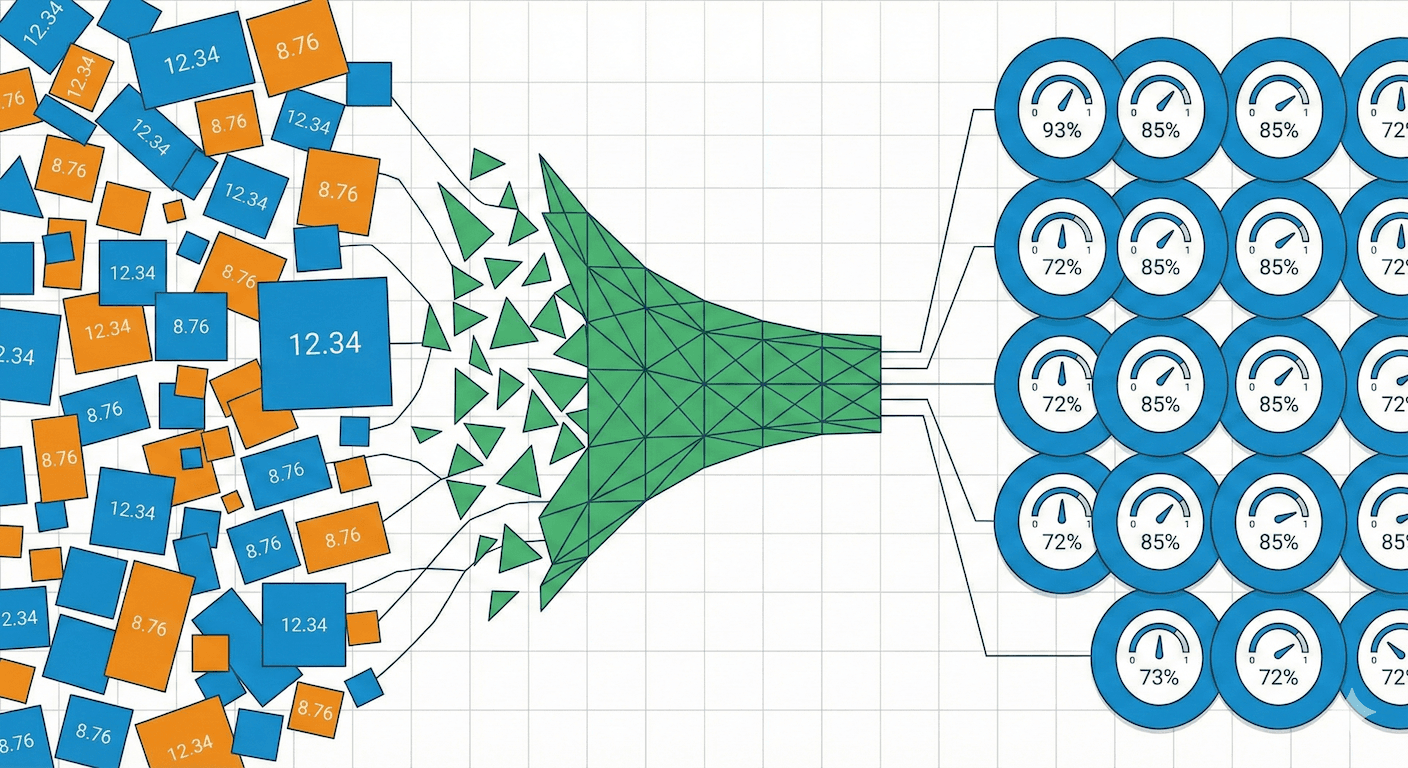
Modern search systems struggle to combine lexical matching with semantic understanding. We explore how we built a probabilistic ranking framework in Cognica Database that transforms BM25 scores into calibrated probabilities, enabling principled fusion of text and vector search results.

Read Post

Insights5 min read
Cognica ERP eliminates the complexity of data integration, instantly providing answers not only to 'what' but also 'why' and 'what's next,' creating business competitiveness.

Read Post

Engineering14 min read
Explains the limitations and characteristics of vector embeddings and covers the improvements made to store them.

Read Post

Insights5 min read

Why Did OpenAI Acquire Rockset?

by Tim Yang | July 11, 2024
On June 21, 2024, OpenAI announced the acquisition of database startup Rockset. According to OpenAI, the background of the Rockset acquisition is to improve search infrastructure to make AI more useful. Specifically, what advantages led OpenAI to acquire Rockset?

Read Post

Engineering13 min read

Searching Case Law Data with Natural Language

by Cognica Team | July 4, 2024
Explains how to build a natural language search service by applying vector search to a case law search demo using FTS.

Read Post

Engineering10 min read

Making Case Law Data Quickly Searchable

by Cognica Team | June 21, 2024
Explains the process of downloading case law data and building a case law search service in just one day using Cognica.

Read Post

Engineering20 min read
We explain the process of data collection and processing, search, and service development for product search using Cognica. Learn how to index when structured and unstructured data are mixed, and how to transform queries for search using LLM.

Read Post

Insights5 min read
You can easily create RAG (Retrieval Augmented Generation) with just one AI database without complex infrastructure setup.

Read Post

Case Studies9 min read
Methods to overcome the limitations of Large Language Models (LLMs) by utilizing Vector Databases (VectorDBs) are gaining attention. To provide accurate answers on specialized information such as law firm case precedents or company communication records—domain data that is not included in the training data—we can use a Vector Database that can convert, store, and search all kinds of data into vector embeddings, serving as a long-term memory storage for LLMs. To illustrate this, we examine a concrete case of how a vector database can complement an LLM through processes like data preprocessing, vectorization, storage, and search, using a Q&A system based on Wikipedia.

Read Post

1 / 2

Copyright (c) 2023-2026 Cognica, Inc.