Insights23 min read
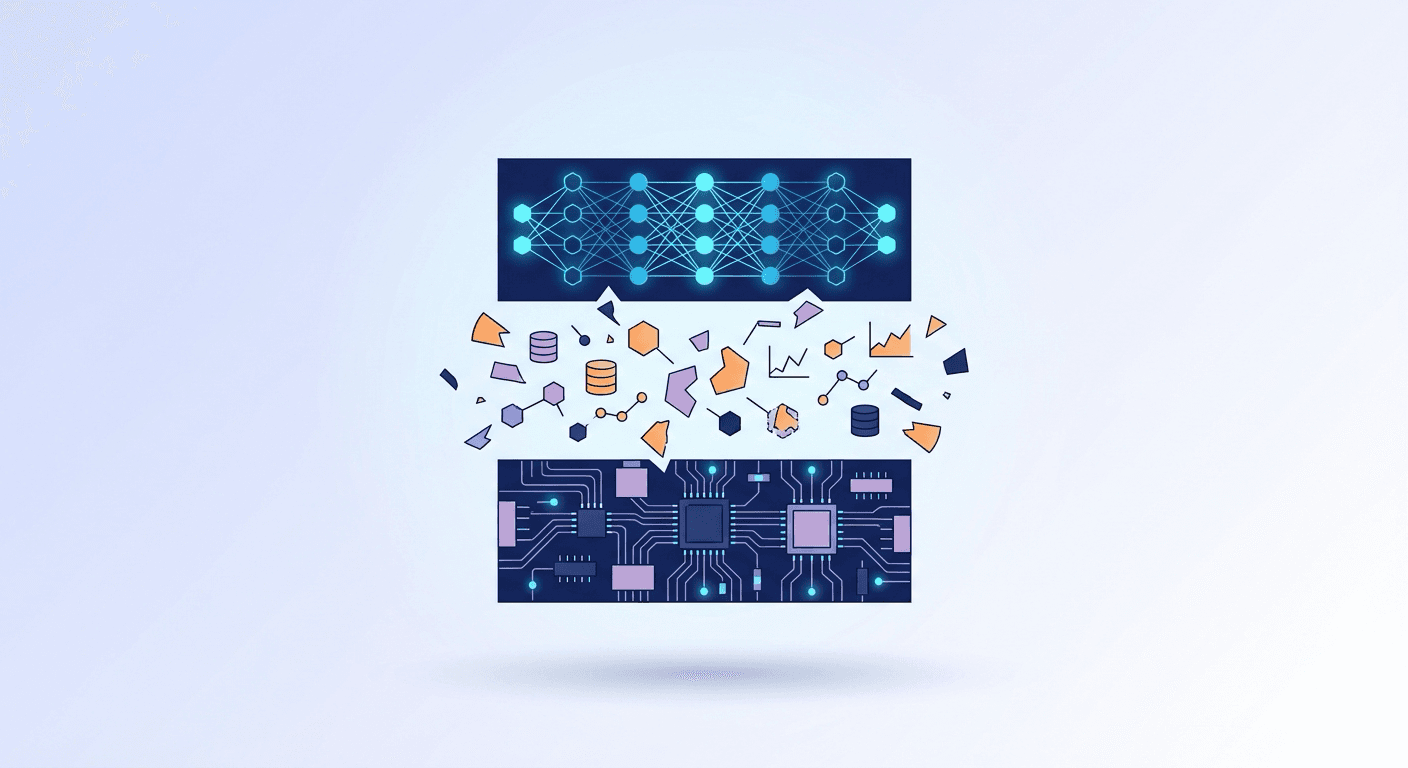
Between models and hardware lies an invisible structural gap — a data layer that should exist but doesn't. We examine why the current AI infrastructure stack is fragmented, why this is a structural problem rather than a transitional one, and what conditions a proper solution must satisfy. We then present UQA and the Cognica engine as one concrete response to these conditions.

Read Post


Insights4 min read
We examine the database architecture changes required by on-device AI. Just as SQLite was the answer for on-device computing, on-device AI requires a new database that integrates transactions, analytics, full-text search, and vector search. We explain why Cognica works identically on-device and on servers.

Read Post

Insights5 min read
This article provides a technical analysis of why legal case search is challenging in the legal services market. We examine the structural characteristics of legal case data and the limitations of existing distributed architectures (RDB + ElasticSearch + Vector DB), and explain why integrated search based on a single database is necessary.

Read Post

Insights3 min read
Exploring how function-based distributed database architectures become structural constraints in the AI era. We examine the limitations and complexity of traditional approaches combining OLTP, OLAP, FTS, and Vector DB, and introduce Cognica's unified database as a technical turning point.

Read Post

Insights6 min read

Why a Single Database?

by Tim Yang | November 11, 2025
Moving beyond the complexity and limitations of the era of specialized databases, we explore why a unified database is now essential. Discover the value of Cognica's integrated database that provides OLTP, OLAP, cache, FTS, and vector search in a single engine, and the future direction of databases in the AI era.

Read Post

Insights5 min read
Cognica ERP eliminates the complexity of data integration, instantly providing answers not only to 'what' but also 'why' and 'what's next,' creating business competitiveness.

Read Post

Insights5 min read

Why Did OpenAI Acquire Rockset?

by Tim Yang | July 11, 2024
On June 21, 2024, OpenAI announced the acquisition of database startup Rockset. According to OpenAI, the background of the Rockset acquisition is to improve search infrastructure to make AI more useful. Specifically, what advantages led OpenAI to acquire Rockset?

Read Post

Insights5 min read
You can easily create RAG (Retrieval Augmented Generation) with just one AI database without complex infrastructure setup.

Read Post

Insights3 min read
Many services are introducing recommendation systems to increase user retention time in modern applications, and this is an important factor directly related to sales, especially in content and e-commerce sectors. Recommendation systems analyze user behavior to understand their interests and provide related items, thereby increasing retention time and inducing purchases. How can vector databases be utilized in this context?

Read Post

Insights4 min read

Why We Need Vector Search

by Tim Yang | September 14, 2023
The mobile applications and web services we use have search functions. Most are developed using basic text search provided by databases or full-text search provided by search engines like Elasticsearch. Full-Text Search is one of the traditional methods mainly used for searching text data, focusing on finding specific keywords, words, phrases, etc., in documents, web pages, databases, and more. It typically involves inputting keywords or short sentences to search text data and finding documents that match the keywords, but it does not consider context or semantic similarity.

Read Post

1 / 2

Copyright (c) 2023-2026 Cognica, Inc.